Vim Show Line Number
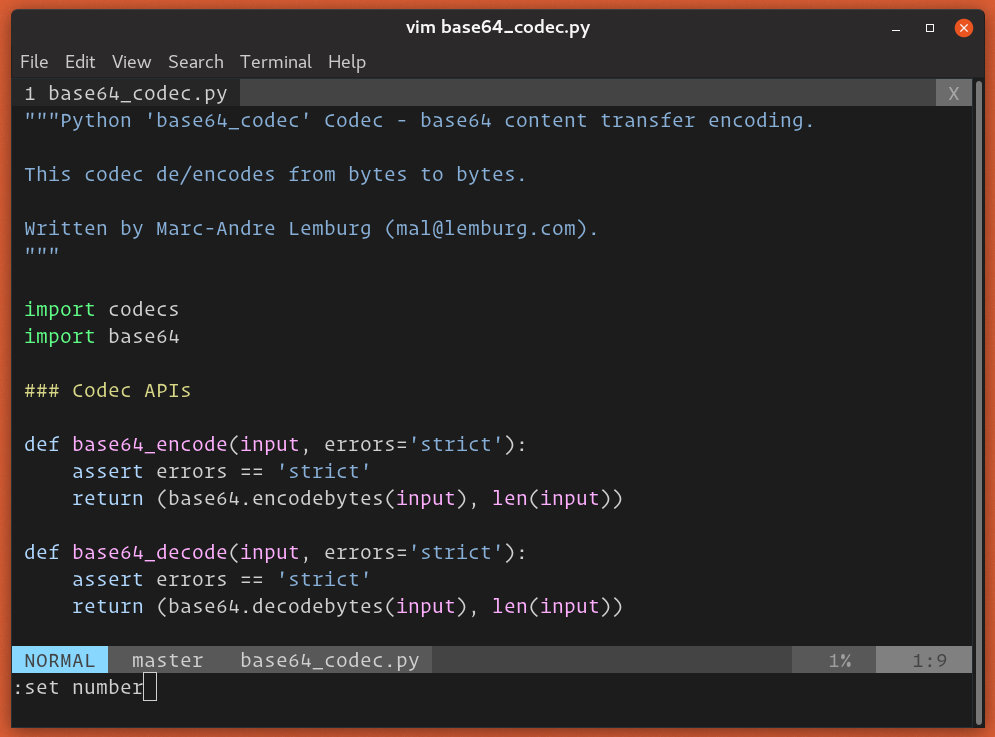
Vim Show Line Number. This will set line numbers when you enter command line mode. This will show the line numbers in the left margin.
Throughout our lives we are inundated with numbers. The world is populated with numbers. time, numbers that count things as well as numbers to measure things, and numbers to count what we have and also numbers to construct things. There are complex numbers, odd numbers in addition to Roman numerals. They have a long background and are still utilized today. There are a few important points you need to know about these numbers.
Ancient EgyptiansIn the IV and third dynasties, ancient Egyptians were in a golden era of peace and prosperity. There was peace, prosperity and stability. Egyptians believed in the gods and were very committed to family life and family worship.
Their physical culture was affected by the Nile River. The Egyptians constructed huge stone structures. They also utilized the Nile to transport goods and trade.
Egyptians dressed in clothes that were simple and practical. They wore a sleeveless coat or a skirt made of linen. It was not uncommon to wear a necklace. Women would often paint their faces and nails. Men wore fake beards, and wigs. They painted their lips with something black called kohl.
Roman numeralsBefore the invention printing presses, Roman numerals that represented numbers were carved on the surface or painted. Later, the technique of placing smaller digits before the bigger ones became popular across Europe.
There are two kinds of Roman numerals, one that is for whole numbers, and another for decimals. The first is a collection that comprises seven Latin characters, every representing a Roman numeral. The second is a set made up of letters that originate from the Greek tetra.
Unlike modern numbers, Roman numerals were never standardized. The usage of Roman numerals was varied throughout the era of ancient Rome as well as the Middle Ages. They are still in use in various places, for example, IUPAC nomenclature used in inorganic chemistry or naming the polymorphic phases of crystals and naming different volumes of books.
Base-ten systemThe counting system in base 10 has four basic concepts. This is among the most used numerical systems. It also serves as the foundation for place value number systems. It is helpful for all students.
The foundation ten system is founded upon the repeated groups of ten. Each group has its distinct value, and the worth of a number is determined on the position it occupies in the numeral. You can find 5 places within the group of ten and the worth of the numeral varies with respect to your group's size.
The base ten system is a wonderful way to teach the basics of subtraction and counting. It is also a good method check students' knowledge. Students can subtract or add 10 frames without difficulty.
Irrational numbersIn general, irrational values are real numbers which cannot be written in ratios or fractions, or expressed as decimals. There are however exceptions. For example the square root of a non-perfect square is an unreal number.
From the time of the 5th century BC, Hippasus discovered irrational numbers. However, he didn't throw them into the sea. He was a member of the Pythagorean order.
The Pythagoreans believed that irrational number were mathematical errors. They also believed that irrational figures were absurd. They ridiculed Hippasus.
At the end of 17th-century, Abraham de Moivre used imaginary numbers. Leonhard Euler also employed imaginary numbers. He also developed the theory of Irrationals.
Additive and multiplication inverse of numbersWhen we use the properties that real numbers have, we can simplify complex equations. These attributes are based on concept of multiplication and the addition of. When adding a negative number in a positive way, it creates a zero. An associative attribute of the number zero is an extremely useful property to utilize in algebraic expressions. It applies to both multiplication and addition.
The reverse of a number "a" may also known as the opposite numbers "a." The additive inverse number "a" produces a zero result when it is added"a" to "a." It is also referred to as the "signature modification".
A good way to prove the associative property is by organizing numbers in a manner which does not alter the values. The property associative is valid for multiplication, division and division.
Complex numbersPeople who are interested in mathematics should be aware of the fact that complex numbers represent the sum of the real and imaginary parts of a given number. They are a subset from reals that are useful in diverse range of. Particularly complex numbers are very useful in the calculation of square roots as well as finding those with negative root in quadratic equations. They also have applications in processes for signal processing, fluid mechanics, and electromagnetism. They are also employed in algebra, calculus, also in analysis of signals.
Complex numbers are defined by distributive and commutative laws. One example of the term "complex number" is that z = x + iy. The actual part of the complex number is shown by the complex plane. The imaginary number is shown by the letter the letter y.
Ensure you are in command mode by hitting esc. Press “:” or colon, so that the cursor goes to the bottom left of your screen. Vim can show and hide line numbers in editor.
This Will Set Line Numbers When You Enter Command Line Mode.
Make sure you're in command mode: The last step is using the. Type either two of the following scripts:
Here Are Vim Commands For It.
(the colon) type the following command: To verify the line number is what you expected, open a text file with vim. Set number to turn off line numbering,.
Line Numbers Will Appear On The Left Side Of The Screen:
First open your file in vim. :set nu disabling this will turn off the line number display: Ensure you are in command mode by hitting esc.
Necessary Steps To Display The Line Numbers In Vi/Vim:
The following command will not show line numbers when. The command to do that is set nu. Press “:” or colon, so that the cursor goes to the bottom left of your screen.
Open Your Terminal And Run The Following Command:
:set number vim enable line numbers. Command :set number or :set nu will display line numbers command :set nonumber or :set nonu will remove line numbers to enable the display of line numbers. :set nonu the following command is useful because it toggles the.
Post a Comment for "Vim Show Line Number"